What is XRP? How It Works, Uses and Future
- Inocyx
- September 8, 2026
- Cryptocurrencies
- Cross-border crypto payments, Cryptocurrency for Beginners, Fast crypto transactions, How XRP works, Ripple payments, Ripple XRP, What is XRP, XRP, XRP blockchain, XRP cross-border payments, XRP cryptocurrency, XRP explained, XRP explained for beginners, XRP for beginners, XRP future, XRP investment, XRP Ledger, XRP payments, XRP technology, XRP uses
- 0 Comments
Introduction to XRP and Its Role in Global Payments
Cross-border money transfers should be quick, efficient, and easy—instead, they’re slow, costly, and cumbersome. This is precisely the problem XRP solves.
If you have been asking yourself, “What is XRP?”, know that it is an innovative solution that enables the instant transfer of funds between countries. The use of XRP cryptocurrency allows for rapid cross-border payments crypto transactions.
What sets XRP apart from other projects is its practicality, not the hype. Indeed, XRP is meant to be used in the real world, particularly when making payments via the Ripple payments systems, where efficiency is key. It is no wonder that XRP has gained relevance in light of the need for fast crypto transactions.
What is XRP and How Does It Work
Here’s the simple explanation: What is XRP?.
XRP is a cryptocurrency operating on the XRP ledger platform, which is highly scalable and fast while being inexpensive. Unlike other digital currencies, XRP does not require mining for transactions to be verified.
How does XRP actually work?
- The transactions on XRP are validated by using the consensus algorithm (not mining)
- The payment process takes only 3–5 seconds
- Transaction fees are very low
- XRP works as a bridge between different currencies
Think about transferring INR into USD without any need to involve numerous banks. Exactly! It is all done within seconds using XRP and cross-border payments crypto solutions.
That explains why XRP is commonly used in the Ripple payments networks for fast crypto transactions.
Who Created XRP and Why Was It Developed
XRP was developed by:
- Chris Larsen
- Jed McCaleb
- David Schwartz
And their goal was straightforward: to address a broken system.
International transactions are too slow, too costly, and too archaic. The purpose of XRP was to remove these problems and enable Ripple payments that were efficient, dependable, and economical.
Rather than compete with banks, XRP complements them, enhancing global financial systems.
When Was XRP Launched and How Has It Evolved
XRP was created by Ripple Labs back in 2012.
In the following years, it has undergone several stages of evolution:
XRP Evolution Timeline
- 2012 – Creation of the XRP Ledger
- 2017 – Sudden increase in XRP market value and popularity
- 2020 – Regulatory problems occurred
- Present Day – Adoption and practical usage
Over time, it became clear that XRP was much more than a simple cryptocurrency but a long-term solution with actual XRP uses.
What Technology Powers the XRP Ledger
The core of the XRP ecosystem is the XRP ledger, among the most efficient blockchains in the crypto environment.
Why XRP Ledger is special
- Capacity to process up to 1500+ transactions per second
- Low costs
- Not mined = Eco-friendly
- Ultra-security and scalability
These features make XRP an ideal choice for performing fast crypto transactions and cross-border payments in crypto systems.
How Has XRP’s Market Value Grown Over Time
The XRP market value has experienced exponential growth and dramatic falls—just like the entire crypto market.
What influences the XRP market value?
- Financial institution adoption
- Market trends and investor sentiment
- Regulatory news
In spite of all fluctuations, XRP manages to stay at the top of the list of cryptocurrencies due to the great purpose of XRP and its practical use in real life.
What Role Does XRP Play in the Crypto and Financial Industry
XRP doesn’t attempt to be all things, but rather excels at being good at one task: global money transfers.
Role of XRP
- Facilitates quick cross-border transfers
- Decreases transaction fees for banks
- Increases liquidity
- Underpins the worldwide Ripple payment networks
Whereas most cryptos are merely speculative, XRP differentiates itself by addressing practical issues through fast cryptocurrency transactions.
What Are the Real-World Uses of XRP and Where Is It Applied
But the true potential of XRP can be seen in its practical XRP uses. Here they are.
Top XRP Uses
1. Cross-border Payments
XRP can be used in cross-border payments crypto systems, which enable fast and cheap transactions around the world.
2. Bank Use
Banks employ XRP for Ripple payment purposes.
3. Liquidity
XRP serves as a bridge currency, eliminating the necessity of having pre-funded accounts.
4. Remittance Services
XRP can make international remittances quicker and more affordable.
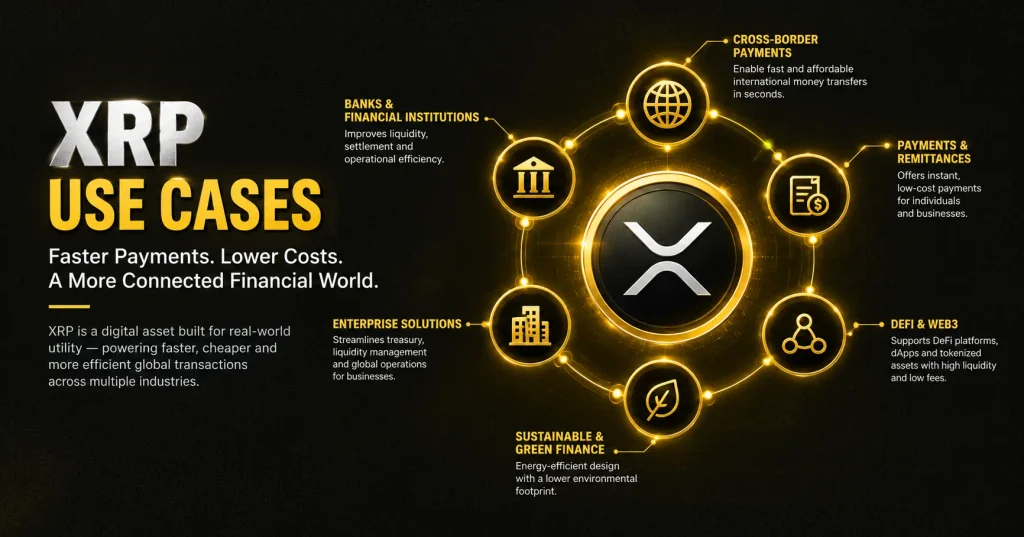
All of these XRP uses demonstrate their practical value in current financial systems.
What is the Future Outlook for XRP
Now, how about the future of XRP?
There is huge potential but also some issues.
Why does XRP have good prospects?
- Rising demand for fast crypto transactions
- Usage increase in the financial sector
- Expansion of cross-border payments crypto solutions
Issues that may arise
- Uncertain regulatory framework
- Presence of competing blockchain technologies
However, the specific purpose of XRP puts it ahead of many other coins. With further adoption, it can turn into the backbone of global payments infrastructure.
Conclusion
In its essence, what is XRP? It is not only a cryptocurrency; it’s an innovation intended to revolutionize the way funds move around the world.
Equipped with its efficient XRP Ledger, growing XRP uses, and strong presence in Ripple payments, XRP is definitely geared towards the future. More than its rising value, the purpose of XRP should be considered.
The increasing demand for fast crypto transactions means a bright future for XRP.
FAQs
What is XRP?
XRP refers to a cryptocurrency that facilitates cross-border payments crypto systems to enable swift and cost-effective transactions through the XRP ledger.
How does XRP work?
XRP functions using a consensus algorithm which helps verify transactions instantly without mining, thus enabling fast crypto transactions.
Who created XRP?
Chris Larsen, Jed McCaleb, and David Schwartz created XRP.
Why was XRP developed?
The purpose of XRP is to speed up international transactions
When was XRP launched?
XRP was launched by Ripple Labs in 2012.
What makes XRP different from other cryptocurrencies?
XRP focuses on functionality, especially when it comes to cross-border payments, crypto solutions using cryptocurrencies, and faster transactions.
What is XRP used for?
Some common XRP uses include making payments, transfers, and managing liquidity.
Disclaimer: Crypto products and NFTs are unregulated and can be highly risky. There may be no regulatory recourse for any loss arising from such transactions.